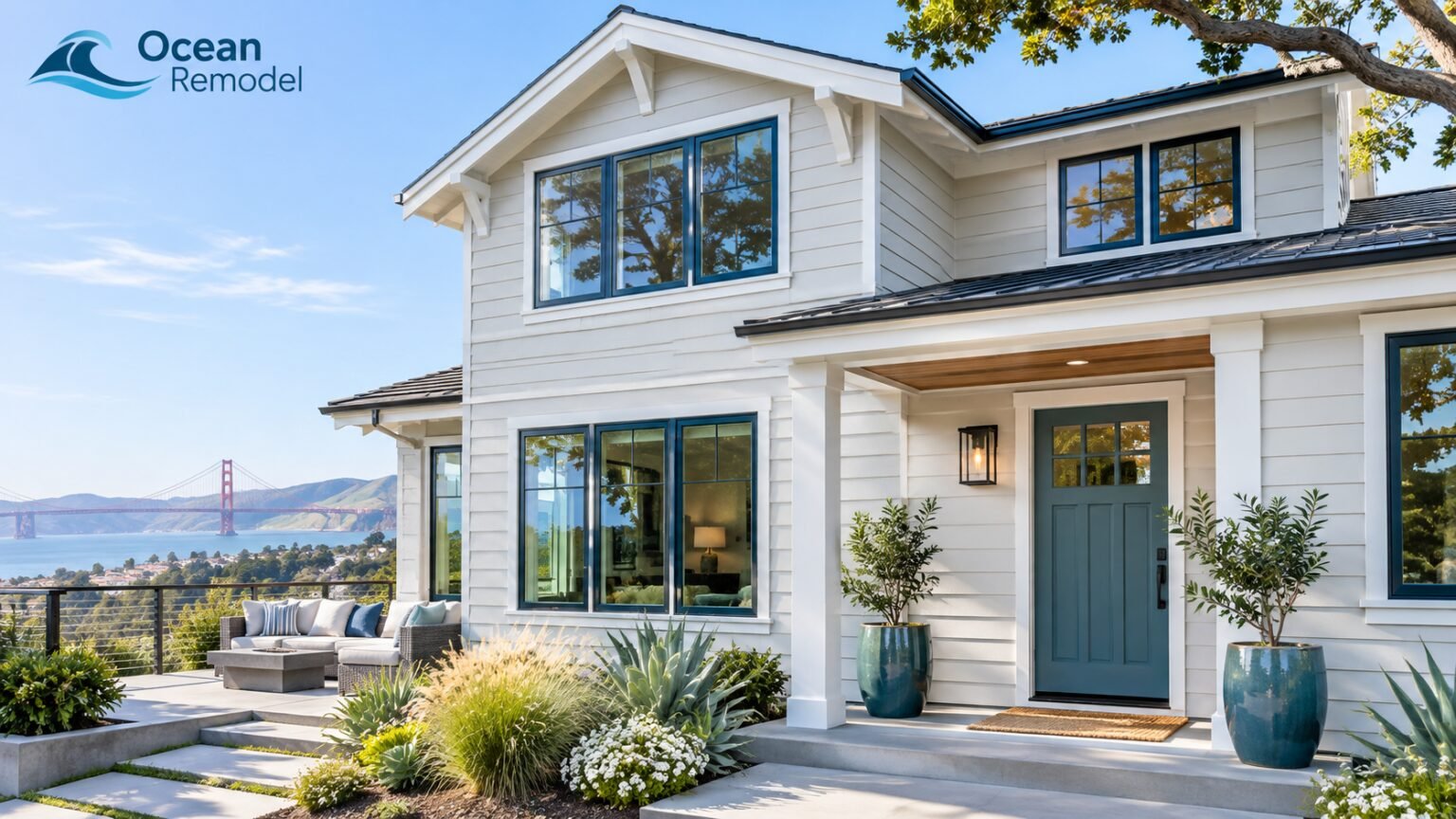
Siding Replacement in the Bay Area in 2027: Costs, Best Materials, Permits & Design Ideas
The Complete Homeowner’s Guide by Ocean Remodel
Updated November 2026 | Serving Walnut Creek, CA, the East Bay, and the Peninsula
Your home’s siding does much more than determine how the exterior looks. It helps protect the structure from rain, wind, sunlight, and moisture while contributing to the architectural character and long-term maintenance needs of the property.
For Bay Area homeowners planning siding replacement in 2027, choosing the right material is only part of the decision. Installation quality, weatherproofing, wildfire considerations, permits, and long-term costs all deserve attention.
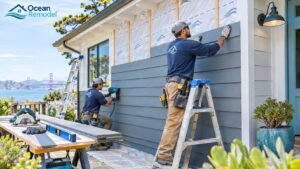
A home in Walnut Creek, CA faces different environmental conditions than a property in Burlingame or San Mateo. Inland heat, coastal moisture, seasonal rain, and site-specific wildfire exposure can influence which siding system makes the most sense.
At Ocean Remodel, we help homeowners plan exterior improvements around durability, modern design, and practical construction decisions.
This guide explains what to expect when replacing house siding in the Bay Area, including estimated costs, material comparisons, California building requirements, and the questions you should ask before hiring a contractor.
At a Glance: What Should Bay Area Homeowners Know About Siding Replacement in 2027?
For many Bay Area homes, fiber cement siding is a strong option because it combines design flexibility, durability, and favorable fire-performance characteristics. However, the right solution depends on your home’s location, construction, condition, and budget.
Published 2026 Bay Area estimates place installed fiber cement siding at approximately $12–$19 per square foot of exterior wall area. These figures are preliminary planning benchmarks, not confirmed 2027 prices or Ocean Remodel quotations.
The most important considerations are:
- Climate: Match the siding system to coastal moisture or inland sun and heat.
- Weather protection: Inspect the water-resistive barrier, flashing, and underlying wall before installing new cladding.
- Fire exposure: Check the property’s wildfire hazard designation and applicable local requirements.
- Project scope: Understand whether the quote includes demolition, disposal, repairs, insulation, trim, and permits.
- Long-term value: Compare lifetime maintenance and appearance, not just initial material costs.
A carefully planned siding project should improve your home’s appearance while addressing the conditions that caused the old siding to deteriorate.
1. Why Siding Replacement Matters for Bay Area Homes
The San Francisco Bay Area contains several distinct microclimates. That makes selecting exterior siding more complicated than simply choosing the most attractive material.
Coastal Moisture and Seasonal Rain
Properties in Burlingame, San Bruno, and parts of San Mateo may experience frequent marine moisture and wind-driven rain.
When water enters behind siding and cannot drain or dry effectively, it may damage wood sheathing, framing, or interior finishes.
A successful siding replacement must consider the complete wall assembly, particularly window openings, penetrations, and horizontal transitions.
Inland Heat and UV Exposure
Homes in Walnut Creek, Lafayette, and other inland East Bay communities often experience hotter summers and stronger direct sunlight than coastal neighborhoods.
Prolonged exposure can affect paints, finishes, caulking, and some siding products.
Product selection should consider heat performance, expansion and contraction, finish durability, and manufacturer installation requirements.
Wildfire Exposure in Certain Neighborhoods
Wildfire preparedness is another important consideration, especially for properties near vegetation, open spaces, and designated fire hazard areas.
Not every Bay Area home is subject to the same construction requirements. Hazard classifications and applicable code provisions depend on the property’s location and the nature of the proposed work.
California’s 2025 Building Standards Code became effective on January 1, 2026. It includes a dedicated California Wildland-Urban Interface Code under Title 24, Part 7.
Homeowners should verify requirements with their building department before selecting materials.
For additional guidance, visit CAL FIRE’s Home Hardening resource.
2. How Much Does Siding Replacement Cost in the Bay Area in 2027?
One of the most common questions homeowners ask is:
“How much does it cost to replace siding on a house in the Bay Area?”
The answer depends on the total exterior wall area, material, demolition requirements, labor, accessibility, and any hidden repairs.
Because 2027 contractor pricing is not yet established as of this guide’s November 2026 update, the following figures use publicly available 2026 regional estimates.
Estimated Bay Area Siding Costs by Material
| Siding material | Published 2026 installed estimate | Key consideration |
|---|---|---|
| Vinyl siding | $6–$12 / sq. ft. | Lower initial cost; verify heat and fire suitability |
| Engineered wood siding | $9–$15 / sq. ft. | Wood-like appearance; detailed moisture protection required |
| Fiber cement siding | $12–$19 / sq. ft. | Durable option with flexible architectural styles |
These are approximate market-level figures for exterior wall area, not floor area. They are not guarantees, official 2027 rates, or project-specific estimates. Scope and exclusions vary by contractor. Wood, metal, and stucco systems require separate quotations.
Example: Estimating a Fiber Cement Siding Project
Consider a home with approximately 1,500 square feet of exterior wall surface receiving new siding.
Using the 2026 regional fiber cement planning range:
- 1,500 sq. ft. × $12 = $18,000
- 1,500 sq. ft. × $19 = $28,500
Illustrative base range: $18,000–$28,500.
This example is not a quote. It does not establish whether wall repairs, unusual access, permits, additional insulation, or specialized demolition are included.
A home with 2,000 square feet of living space does not necessarily have 2,000 square feet of siding. Exterior wall measurements must be calculated separately.
What Can Increase the Final Cost?
Several factors influence a siding replacement estimate.
Existing siding removal: Removing old siding can reveal multiple layers of materials, degraded sheathing, or concealed construction problems.
Water damage: Damaged wood, failed flashing, and compromised wall assemblies must be assessed before new materials cover the area.
Two-story access: Tall walls, steep sites, and limited side-yard access may require additional equipment or scaffolding.
Architectural complexity: Bay windows, dormers, multiple gables, unusual corners, and decorative trim increase installation complexity.
Material and finish selection: Factory-finished products, architectural panels, custom trim, and premium finishes may change the budget.
Permits and documentation: Local jurisdictions may require drawings, product information, inspections, or other documentation.
For an accurate price, request an estimate based on actual field measurements and a clearly defined scope.
3. What Is the Best Siding Material for Bay Area Homes?
There is no universal best siding material.
The ideal choice balances weather resistance, maintenance, appearance, budget, and local building requirements.
Fiber Cement Siding: A Strong All-Around Choice
Fiber cement is manufactured from cementitious materials and reinforcing fibers. It is available in horizontal planks, panels, shingles, and architectural profiles.
Products such as James Hardie siding are popular options for homeowners seeking a clean, premium exterior.
Advantages can include:
- Resistance to many common moisture-related deterioration problems
- A wide selection of textures and architectural styles
- Low-maintenance options compared with traditional painted wood
- Strong fire-performance characteristics for qualifying products
- Compatibility with modern, coastal, Craftsman, and transitional designs
Fiber cement still requires proper installation, compatible flashing, appropriate clearances, and periodic maintenance.
It is also heavier than some alternative siding materials, so cutting, fastening, handling, and installation details matter.
Best suited for: Homeowners prioritizing durability, a refined exterior appearance, and reduced routine maintenance.
Learn more about available siding options through Ocean Remodel’s Exterior Services.
Engineered Wood Siding: A Warm, Contemporary Alternative
Engineered wood siding uses manufactured wood-based materials designed for exterior applications.
It can offer the appearance of natural wood with consistent profiles and a range of finish options.
Advantages may include easier handling compared with heavier cladding products and a relatively competitive initial cost.
However, engineered wood must be installed according to the manufacturer’s requirements. Cut edges, exposed areas, fasteners, and moisture-sensitive details deserve particular attention.
Not every engineered wood product is suitable for every wildfire exposure condition.
Best suited for: Homeowners seeking a modern wood-inspired design where the selected product satisfies site conditions and applicable codes.
Natural Wood Siding: Timeless California Character
Natural wood has long been associated with California residential architecture.
It can be especially attractive on Craftsman homes, traditional houses, and carefully designed contemporary exteriors.
Wood offers natural variation and can be finished in numerous ways.
However, owners should plan for ongoing inspection and maintenance. Depending on the species, finish, exposure, and installation, wood may be susceptible to deterioration, insects, and moisture-related movement.
Its combustible nature also requires particular consideration in wildfire-prone areas.
Best suited for: Homeowners who value natural materials and are comfortable with the required maintenance and any applicable fire restrictions.
Vinyl Siding: A Budget-Focused Option
Vinyl siding is often considered because of its relatively low upfront cost.
It is available in multiple colors and profiles and generally does not require traditional repainting.
Its suitability depends on the specific product and exposure conditions. Heat, physical damage, expansion and contraction, and fire-related restrictions should be considered.
For premium Bay Area renovations, homeowners may also prefer the visual depth and architectural details offered by other cladding products.
Best suited for: Cost-conscious projects where the material meets the home’s performance, design, and code requirements.
Stucco: A Different Exterior Finish Option
Stucco is not interchangeable with conventional lap or panel siding. It is a separate exterior cladding system with its own assembly, moisture-management, and installation requirements.
It remains an attractive option for modern California, Mediterranean, and contemporary homes.
Poorly detailed stucco systems can experience cracking or moisture problems, particularly around transitions and openings.
Best suited for: Properties where stucco matches the architectural style and a properly designed assembly can be installed.
4. Fiber Cement vs. Wood vs. Vinyl: Which Material Should You Choose?
| Consideration | Fiber cement | Natural wood | Vinyl |
|---|---|---|---|
| Modern design flexibility | Excellent | Excellent | Good |
| Maintenance requirements | Generally moderate to low | Often higher | Generally low |
| Moisture considerations | Requires correct wall detailing | Requires careful protection | Requires correct drainage system |
| Fire considerations | Qualifying products offer strong performance | Combustible | Product- and location-dependent |
| Natural wood appearance | Available in textured profiles | Authentic | Simulated |
| Initial budget | Higher | Highly variable | Often lower |
The important distinction is that siding is only one component of the exterior wall.
An expensive siding product will not compensate for poorly installed flashing, inadequate drainage, or concealed water damage.
For homeowners planning a long-term renovation, a system-based approach is generally more useful than comparing products by appearance alone.
5. James Hardie Siding in the Bay Area: Is It Worth Considering?
James Hardie fiber cement siding is one of the product families worth evaluating for a Bay Area exterior renovation.
Ocean Remodel’s existing exterior services include James Hardie fiber cement, wood siding, and stucco systems.
Popular James Hardie design categories include horizontal lap siding, vertical panels, and shingle-style details.
Horizontal Lap Siding
Horizontal lap siding creates a timeless appearance that works well on ranch-style, Craftsman, coastal, and transitional homes.
It can be paired with contrasting trim, dark windows, and restrained architectural accents.
Board-and-Batten Style
Board-and-batten designs use vertical lines to create a taller, more contemporary visual effect.
This style works particularly well on gables and selected architectural sections.
The underlying panel system, battens, joint details, and water-management components must be compatible with the selected installation method.
Architectural Panel Siding
Large-format siding panels can create a clean, minimal appearance.
They are often used on contemporary homes that emphasize simple geometry and crisp exterior lines.
Installation requires careful planning around panel joints, transitions, fasteners, and penetrations.
Is James Hardie Siding Fireproof?
Homeowners should distinguish between the fire performance of an individual cladding product and the performance of the complete exterior wall assembly.
Certain fiber cement products are classified as noncombustible under applicable test methods. However, that does not make an entire house fireproof.
Wildfire resilience also depends on windows, vents, roofs, decks, landscaping, openings, and the details connecting these systems.
Confirm the specific product and assembly requirements with the manufacturer and local building official.
For installation specifications, consult James Hardie’s official technical documentation.
6. Siding Replacement and California Wildfire Requirements for 2027
Wildfire considerations have become increasingly important in exterior remodeling decisions throughout California.
The California Wildland-Urban Interface Code provides construction standards designed to improve building resistance to wildfire exposure in applicable areas.
The current code framework became effective in January 2026.
Does Every Home Need Fire-Resistant Siding?
No. Requirements vary according to the property’s location, hazard designation, project scope, and applicable local rules.
A home in central Walnut Creek may have different requirements from a property near undeveloped hillsides.
Homeowners should verify their property’s classification rather than assume that every address is regulated identically.
What Makes an Exterior More Wildfire-Resilient?
CAL FIRE identifies vulnerable areas including combustible siding, gaps, damaged exterior coverings, and places where embers can accumulate.
Risk-reduction measures may include:
- Replacing vulnerable cladding with an appropriate noncombustible or ignition-resistant alternative
- Sealing or repairing openings and damaged exterior components
- Properly detailing roof-to-wall transitions
- Reducing combustible materials near the building
- Inspecting decks, vents, windows, and eaves
A siding replacement project can be an opportunity to assess these connected exterior components.
Review CAL FIRE’s wildfire construction guidance before planning work in a designated fire hazard area.
Important: New-construction requirements do not automatically apply in the same way to every existing-home siding repair or replacement. The building department must determine which provisions apply to the specific project.
7. Do You Need a Permit to Replace Siding in Walnut Creek, CA?
Permit requirements are an important part of planning a siding replacement.
Whether a permit is necessary can depend on the amount of siding being removed, associated repairs, changes to the wall assembly, and local jurisdiction requirements.
Walnut Creek’s building department explains its permit procedures through an online portal. The city applies the 2025 California building codes to permit applications submitted from January 1, 2026 onward.
Before Starting Siding Replacement
Homeowners should confirm:
- Whether the proposed removal and replacement requires a building permit
- Whether new sheathing or framing repairs change the permit scope
- Whether the property is within a designated fire hazard area
- Whether exterior insulation or other energy-code requirements apply
- Whether an HOA or architectural review approval is needed
- Which inspections are required before the walls are covered
Requirements may differ between Walnut Creek, Lafayette, Castro Valley, Hayward, Burlingame, Redwood City, and San Mateo.
For local details, review the City of Walnut Creek Building Permits page.
A qualified contractor should help establish the applicable requirements before construction begins.
8. Can New Siding Improve Energy Efficiency?
Potentially, yes. But siding alone should not be treated as a guaranteed energy-saving upgrade.
The biggest opportunity often comes from evaluating the wall while the existing exterior materials are removed.
Depending on the project, improvements may include:
- Repairing damaged weather barriers
- Improving air sealing where appropriate
- Adding or upgrading wall insulation
- Addressing thermal bridging
- Improving flashing and drainage details
California’s 2025 Energy Code includes requirements affecting certain alterations to existing residential buildings.
Whether insulation upgrades are required depends on the specific work and applicable provisions.
For homeowners planning a larger exterior remodel in 2027, discussing insulation and air sealing before installation can prevent unnecessary repeat work.
Learn more from the California Energy Commission.
9. Why the Installation System Matters More Than Appearance Alone
A siding replacement should not simply cover up existing construction problems.
A professionally planned exterior wall relies on several connected components.
The Water-Resistive Barrier
A properly selected and installed water-resistive barrier helps manage water that passes behind the exterior cladding.
The barrier must integrate with windows, doors, penetrations, and flashing systems.
Window and Door Flashing
Window corners, sill areas, and penetrations can be vulnerable to water intrusion.
Incorrect transitions may allow moisture into the wall even when the new siding looks flawless.
Drainage and Drying
Some wall assemblies benefit from dedicated drainage or ventilation spaces behind the siding.
Whether a rainscreen approach is appropriate depends on the product, wall design, site exposure, and applicable requirements.
Correct Clearances
Manufacturer-specified clearances around grade, roofs, decks, and hardscape help reduce prolonged moisture exposure.
Fasteners and Joints
Correct fastener selection, spacing, corrosion resistance, panel movement allowances, and joint treatments are essential to the cladding system.
The best exterior renovation combines appealing materials with construction details that support long-term performance.
10. Repair or Replace: How Do You Know When Siding Is Beyond Repair?
Not every damaged siding panel requires full replacement.
Localized deterioration may be repairable if the surrounding wall is in good condition and compatible replacement materials are available.
However, larger or recurring problems may justify a more comprehensive evaluation.
Signs You Should Schedule a Siding Inspection
Soft or deteriorated wood: May indicate rot or prolonged moisture exposure.
Repeated peeling or bubbling paint: Could result from surface preparation problems or moisture entering from behind the siding.
Warped, cracked, or loose panels: May indicate product aging, physical damage, or installation issues.
Water stains inside exterior walls: Can point to roof, window, flashing, or cladding-related leaks.
Recurring repairs in multiple areas: May suggest that the existing siding system has reached the point where replacement is more practical.
Visible damage around windows and trim: Requires particular attention because these details can allow moisture to enter.
A thorough evaluation should identify the source of the problem rather than simply replace the visibly damaged materials.
When Repair May Make Sense
Repairs may be appropriate when damage is limited, the existing wall remains sound, and the repair can integrate correctly with the current system.
When Replacement May Be the Better Investment
Replacement becomes more compelling when deterioration is widespread, materials are incompatible with the property’s conditions, or repeated repairs fail to solve underlying problems.
The right decision should consider both today’s cost and the likelihood of continued maintenance.
11. Modern Siding Design Trends for Bay Area Homes in 2027
Exterior design is about more than choosing between horizontal and vertical siding.
A well-designed facade should fit the property’s architecture, surroundings, and natural light.
For homeowners considering a premium exterior update, several established design directions are worth exploring.
Warm White Coastal Exteriors
Soft white or warm off-white siding with natural wood accents can create a relaxed California coastal aesthetic.
Dark window frames and restrained landscaping provide contrast without overwhelming the exterior.
Contemporary Board-and-Batten
Vertical siding details can make a traditional home feel more architectural.
Rather than covering every wall in the same pattern, designers can use vertical panels selectively to emphasize entrances and gables.
Natural, Muted Colors
Warm gray, sand, taupe, soft blue-gray, and earthy neutral finishes complement many Bay Area neighborhoods.
These colors can work with wood trim, pavers, and modern landscaping.
Mixed-Material Facades
Combining complementary siding styles can introduce depth and visual interest.
For example, horizontal lap siding may be paired with vertical architectural panels around an entry or upper-story feature.
Different material systems must be detailed correctly wherever they meet.
Integrated Exterior Remodeling
Siding replacement is often most effective when coordinated with windows, exterior painting, roofing details, deck transitions, and landscaping.
Homeowners planning additional exterior work can explore Ocean Remodel’s exterior remodeling services or view our exterior project gallery.
12. What Does the Siding Replacement Process Look Like?
Understanding the construction sequence helps homeowners set realistic expectations.
Step 1: Initial Property Assessment
The contractor inspects the visible siding, wall conditions, architectural details, and access constraints.
The goal is to identify potential complications before finalizing the scope.
Step 2: Material and Design Selection
Homeowners compare siding profiles, colors, trim styles, and maintenance requirements.
Product selection should reflect both the architectural goals and practical site conditions.
Step 3: Written Scope and Estimate
A detailed proposal should define materials, preparation, demolition, repairs, installation details, cleanup, and exclusions.
Potential changes should have a clear approval process.
Step 4: Permits and Preconstruction Planning
The project team establishes whether permits, product documentation, inspections, or other approvals are necessary.
Step 5: Removal of Existing Siding
Existing materials are removed according to the approved scope and appropriate safety procedures.
Concealed conditions become easier to assess during this stage.
Step 6: Wall Repairs and Weatherproofing
The team addresses approved repairs and prepares the wall assembly, including applicable barriers, flashing, insulation, or drainage components.
Step 7: New Siding Installation
Panels, boards, trim, joints, and transitions are installed following the product specifications and applicable code requirements.
Step 8: Final Inspection and Project Closeout
The completed work is reviewed, required inspections are addressed, debris is removed, and maintenance guidance is provided.
How long does the process take?
Timelines vary substantially. A straightforward one-story project may move faster than a multi-story home requiring extensive repairs, specialized access, or permit coordination.
A reliable project schedule should be based on the actual scope, not a universal completion promise.
13. A Special Consideration for Older Bay Area Homes
Many established Bay Area neighborhoods contain houses built before 1978.
When old painted materials are disturbed during renovation, lead-based paint may require special precautions.
The EPA’s Renovation, Repair and Painting Rule generally applies to covered paid renovation work disturbing painted surfaces in pre-1978 homes and certain child-occupied facilities, subject to applicable exceptions.
This matters during demolition and siding replacement because disturbing old paint can create hazardous dust.
Homeowners should discuss applicable lead-safe work practices and contractor certification before construction.
See the EPA’s official RRP Program guidance.
Other potentially hazardous materials should also be evaluated before disturbance where appropriate.
14. How to Choose a Siding Replacement Contractor in the Bay Area
The lowest quote is not always the lowest total cost of ownership.
Before choosing a siding contractor, compare proposals carefully.
Ask each contractor:
- Is the California contractor license current and appropriate for the work?
- What exact siding product, profile, and finish are included?
- Is existing siding removal included?
- How will hidden rot or damaged sheathing be evaluated and priced?
- Which water-management and flashing details are included?
- Who determines and coordinates permit requirements?
- What protections are included for landscaping, windows, and surrounding areas?
- How are scope changes documented and approved?
- What workmanship and manufacturer warranty terms apply?
- What are the payment schedule, estimated timeline, and completion requirements?
A clear proposal should make it easy to understand what you are paying for.
You should also request relevant project examples and verify licensing details independently.
Why Homeowners Consider Ocean Remodel
Ocean Remodel is a licensed Bay Area general contractor, CSLB License #1120751, offering home remodeling and exterior improvement services.
Our exterior offerings include wood siding, James Hardie fiber cement siding, stucco, and related exterior work.
Our approach emphasizes planning, material selection, clear project scopes, and communication throughout construction.
For homeowners in Walnut Creek, CA and surrounding East Bay and Peninsula communities, our goal is to create exterior spaces that combine practical durability with modern California design.
15. Siding Replacement in Walnut Creek, Lafayette, Castro Valley, and the Peninsula
Although the term “Bay Area siding replacement” covers a broad region, local conditions can change the best approach to a project.
Walnut Creek and Lafayette
Inland sun exposure, exterior design, and wildfire considerations in applicable neighborhoods are important factors.
Material selection should account for the home’s site conditions, maintenance expectations, and architectural character.
Castro Valley and Hayward
Properties range from older homes with traditional siding to more contemporary residential construction.
A careful assessment can help determine whether repairs or complete replacement are appropriate.
Burlingame, San Bruno, and San Mateo
Marine moisture, seasonal wind-driven rain, and established residential architectural styles can influence cladding selection.
Drainage, flashing, and appropriate corrosion-resistant components deserve attention.
Redwood City and Belmont
These communities contain a variety of microclimates, hillside conditions, and home styles.
The most suitable siding solution depends on the specific property, not just its ZIP code.
Ocean Remodel serves homeowners across these East Bay and Peninsula communities.
For more information about our exterior services, visit Ocean Remodel.
16. Frequently Asked Questions About Siding Replacement in 2027
How much does siding replacement cost in the Bay Area in 2027?
Final 2027 prices will depend on labor, materials, accessibility, and scope. Published 2026 Bay Area planning estimates for installed fiber cement siding are approximately $12–$19 per square foot of exterior wall area. A site-specific estimate is necessary for accurate budgeting.
What is the best siding for a house in Walnut Creek, CA?
Fiber cement is a strong option for many Walnut Creek homes because of its design flexibility, durability, and favorable fire-performance characteristics in qualifying products. The best choice depends on the property’s specific location, construction, budget, and applicable building requirements.
Is James Hardie siding worth the investment?
It can be a worthwhile choice for homeowners seeking a durable exterior with a refined architectural appearance. The value depends on proper installation, total project cost, maintenance expectations, and how well the product suits the property.
Do I need a permit to replace house siding in California?
Permit requirements vary by city, property, and project scope. Significant siding removal, wall alterations, or related structural work may require permits or inspections. Always verify requirements with the local building department.
Can I replace wood siding with fiber cement?
Often, yes. However, the contractor must evaluate the existing wall assembly, framing, flashing, trim, clearances, and any applicable code requirements before confirming the replacement system.
Is fiber cement siding fire-resistant?
Many fiber cement products have strong fire-performance characteristics, and certain products are classified as noncombustible. Compliance depends on the specific product, assembly, and local requirements. Siding alone does not make a home wildfire-proof.
Should I replace siding or repaint my house?
Repainting may be sufficient if the siding and underlying wall are in good condition. If there is widespread rot, recurring water intrusion, or significant material damage, replacement may be more appropriate.
Can siding replacement help lower energy bills?
It may create an opportunity to improve insulation, air sealing, and weather protection. Savings are not guaranteed by the siding material alone and depend on the existing building and actual improvements.
Can I stay in my house during siding replacement?
Many homeowners can remain in their homes during exterior work. However, noise, access restrictions, temporary weather protection, and the extent of wall repairs may affect the decision.
When should I start planning a siding replacement project for 2027?
Begin with a property assessment, material selection, preliminary budget, and permit review before choosing a construction schedule. Early planning is especially valuable when the project includes windows, exterior insulation, deck transitions, or other improvements.
17. Start Your Bay Area Siding Replacement Project With Ocean Remodel
Replacing your home’s siding is an opportunity to improve much more than curb appeal.
The right project can address aging materials, improve exterior weather protection, modernize the architectural appearance, and reduce recurring maintenance problems.
Whether you are considering James Hardie fiber cement siding, a contemporary board-and-batten design, or a complete exterior transformation, the process should begin with a clear understanding of your property and goals.
Ocean Remodel helps homeowners throughout Walnut Creek, CA, the East Bay, and the Peninsula plan exterior improvements with thoughtful material selection and organized construction.
Planning siding replacement for 2027?
Request a Free Siding Replacement Estimate from Ocean Remodel
Tell us about your existing siding, the type of exterior design you prefer, and the problems you want to solve.
We’ll help you evaluate practical options for your home and prepare for the next steps.
Ocean Remodel | Licensed General Contractor #1120751
Serving Walnut Creek, CA and surrounding Bay Area communities.
Editorial note: Cost estimates reflect published 2026 market information available as of November 2026. Building regulations, product specifications, and project prices should be reconfirmed before work begins in 2027.